Stability and control
Why a trimmed airplane tends to fly itself back to level -- and why the CG position sets the limits of that tendency.
13 min read · Aerodynamics: why the airplane flies
After this lesson you can
- Distinguish static stability from dynamic stability, and describe the three subtypes of each.
- Explain the mechanism that makes a conventional airplane's nose return to trimmed pitch after a gust.
- List the design features that give an airplane lateral and directional stability.
- Explain why moving the CG aft makes an airplane less stable and, eventually, dangerous to recover from a spin.
Stability is the built-in tendency of an airplane to correct, on its own, for whatever disturbed it -- a gust, a bump, a momentary control input -- and to return toward its trimmed condition. It is a property of the airframe's design, not something the pilot does moment to moment; it is what lets you trim an airplane and take your hands off the controls for a few seconds without the situation getting worse.
This lesson explains where that self-correcting tendency comes from on all three axes, and why it is not free: the same forward CG limit that makes an airplane docile and stable also makes it slower and stall at a higher speed, while pushing the CG aft trades stability for efficiency -- and, taken too far, for controllability itself.
1.Static stability and dynamic stability are different questions
Static stability describes only the INITIAL tendency after a disturbance. Positive static stability means the airplane initially tends to return toward its original equilibrium; neutral static stability means it tends to stay in the new condition; negative static stability means it tends to continue moving further away.
Dynamic stability describes what happens over TIME, after that initial tendency. An airplane can have positive static stability (it initially moves back toward level) but still oscillate: positive dynamic stability means those oscillations damp out and shrink over time; neutral dynamic stability means they neither grow nor shrink; negative dynamic stability means they grow and diverge. A trainer airplane is normally designed to be positively stable both statically and dynamically -- it noses back toward trim, and the resulting pitch oscillations die out within a few cycles.
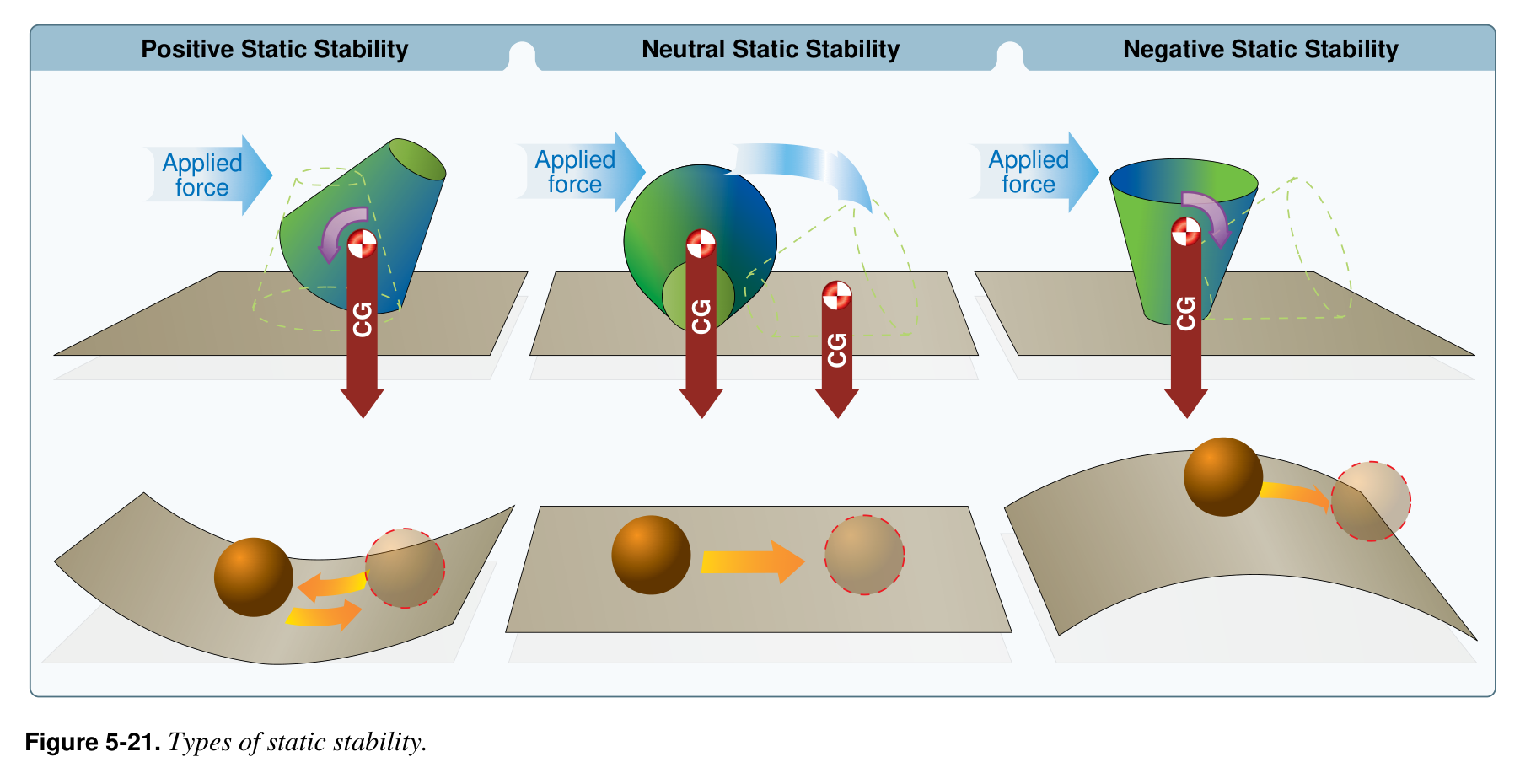
FAA Pilot's Handbook of Aeronautical Knowledge (FAA-H-8083-25C), figure 5-21 - work of the U.S. government, public domain.
Quick check
An airplane is bumped nose-up by a gust. It initially returns toward level, then oscillates in slowly shrinking pitch changes before settling back to trimmed flight. This airplane has:
2.Longitudinal stability: why the tail carries a download
On most airplanes the wing's center of lift sits aft of the CG, making the airplane inherently nose-heavy. Designers compensate by setting the horizontal stabilizer at a slight negative AOA, so airflow from the wing's downwash produces a small download on the tail that balances the nose-heavy tendency -- picture a lever with a strong upward force at the center of lift and two downward forces balancing it, a large one at the CG and a small one at the tail.
This balance is speed-sensitive. Faster flight increases downwash over the tail and increases the download, which pushes the nose down; slower flight reduces downwash and download, letting the nose rise. That is the mechanism behind the classic hands-off demonstration: trim for level flight, push the nose down briefly, and let go. If the nose oscillates back toward level in shrinking swings, the airplane is longitudinally stable -- exactly what you would expect from a well-designed trainer.
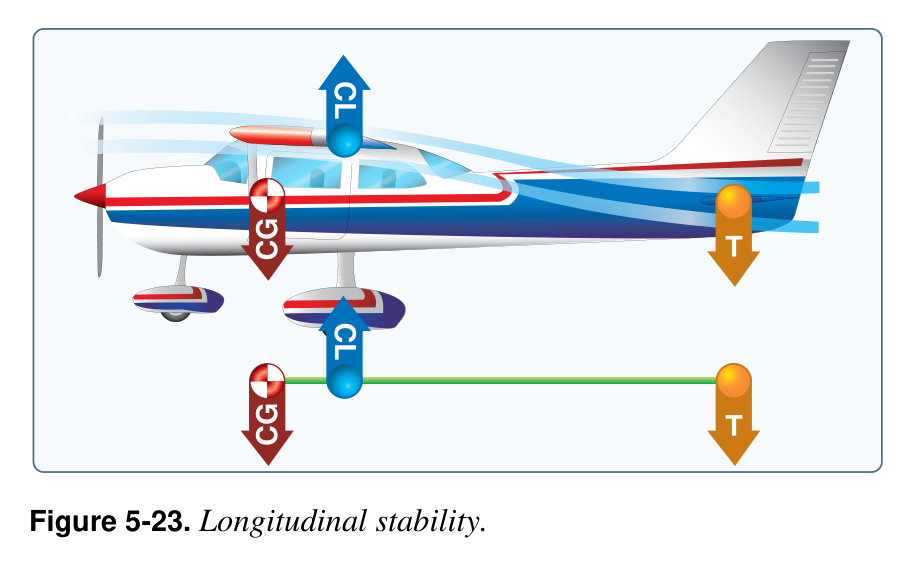
FAA Pilot's Handbook of Aeronautical Knowledge (FAA-H-8083-25C), figure 5-23 - work of the U.S. government, public domain.
3.Power changes the picture too
Adding power can be destabilizing if the thrust line passes below the CG, since that tends to pitch the nose up as power increases; a thrust line passing above the CG has the opposite tendency; a thrust line passing exactly through the CG has no direct pitching effect from power changes. Designers choose which of these best suits the rest of the airplane's stability characteristics.
Reducing power has a related, useful effect: with less slipstream over the tail, downwash drops, the tail's download weakens, and the nose tends to lower on its own -- which is a desirable characteristic, since it is the airplane's own tendency to regain airspeed after a power reduction, not something the pilot has to force.
4.Lateral stability: what keeps the wings level
Lateral stability -- resistance to unwanted roll -- comes mainly from four design features, and most training airplanes combine several of them.
- Dihedral — The upward angle of the wings from horizontal. When a gust drops one wing, the resulting sideslip gives the low wing a slightly higher AOA (and more lift) than the high wing, rolling the airplane back level.
- Sweepback — A wing whose leading edge angles backward. In a slip, the lower wing presents more of its span perpendicular to the airflow, generating more lift and rolling the airplane back level -- roughly 10 degrees of sweep contributes about 1 degree of effective dihedral.
- Keel effect — A high-wing airplane's fuselage hangs below the wing like a ship's keel; in a sideslip, the combination of weight and airflow against the upper fuselage rolls the airplane back to wings-level.
- Weight distribution — Where the fuselage mass sits relative to the CG changes how the airplane behaves as a pendulum when a wing dips -- part of why a high-wing design contributes roughly 5 degrees of effective dihedral over an equivalent low-wing design.
5.Directional stability: the weathervane effect
Directional stability -- the tendency to point the nose back into the relative wind after a yaw disturbance -- comes mainly from the vertical fin and the fuselage area aft of the CG, acting exactly like the feathers on an arrow or a weathervane. For this to work, there must be more side-facing surface area behind the CG than in front of it; if the areas were equal, a yaw disturbance would produce no restoring tendency at all.
A sideways gust that yaws the nose right presses air against the left side of the fin, which resists the turn and starts rotating the nose back toward the relative wind. This restoring action is relatively slow, and it stops once the airplane has stopped skidding -- it does NOT, by itself, bring the airplane back to its original heading. The pilot has to re-establish the original heading; directional stability only stops the disturbance from getting worse.
Quick check
A fuselage and vertical fin provide positive directional stability mainly because:
6.Dutch roll and spiral instability
Strong directional stability combined with weak dihedral (lateral stability) produces a slow, gentle divergence called spiral instability: a disturbed wing dips, directional stability yaws the nose toward the low wing faster than the (weak) dihedral can roll the wings back level, the outside wing speeds up and gains lift, and the bank angle very gradually steepens into a descending spiral. Most training airplanes have some spiral tendency, but it develops so slowly that a pilot can correct it without difficulty in normal flight.
The opposite imbalance -- strong dihedral relative to directional stability -- produces Dutch roll, a coupled rolling and yawing oscillation that most designers consider more objectionable to fly than mild spiral instability, so training airplanes are generally built to lean toward spiral instability rather than Dutch roll.
The graveyard spiral
The PHAK is blunt: improper recovery from spiral instability, leading to inflight structural failure, has probably contributed to more general aviation fatalities than any other single factor. As airspeed builds rapidly in an uncorrected spiral, pulling back on the elevator to slow down only tightens the turn and increases load factor -- the correct recovery is to level the wings first, exactly as in stall recovery, before adjusting pitch. This is why loss of outside visual reference, as in flight into clouds, is so dangerous for a VFR-only pilot.
7.CG position: the tradeoff behind every stability number
A forward CG makes an airplane "heavier" on the nose: more download is needed at the tail to balance it, which the wing must supply as extra lift, which means a higher AOA at any given speed -- and therefore more drag, a slower cruise, and a HIGHER stall speed than the same airplane loaded further aft. It is also the more stable, more forgiving, more docile condition, which is exactly why airplane manuals bias useful-load examples toward the forward half of the CG envelope for student training.
Moving the CG aft relieves the tail download, reduces the AOA (and drag) needed for a given amount of lift, and yields a faster, more efficient cruise -- but it comes at a direct cost to controllability and to stall/spin recovery. An airplane that recovers cleanly from a spin with the CG at one position can fail to respond to normal recovery inputs when the CG moves aft by only an inch or two, which is exactly why aft CG limits for spin-approved airplanes are set with a real safety margin inside the structural aft limit.
Loading is a stability decision, not just a weight-and-balance number
Two loadings can both be inside the CG envelope and legal, and still fly very differently: forward and slower but more stable and more forgiving; aft and faster but less stable and, near the aft limit, meaningfully harder to recover from an upset. You will use this exact idea again in the weight-and-balance lesson of the systems module.
What to remember
- Static stability is the initial tendency after a disturbance (positive, neutral, or negative). Dynamic stability is what happens to that tendency over time (damped, neutral, or divergent oscillations).
- Longitudinal stability comes from the tail's download, set by the horizontal stabilizer's slight negative AOA -- stronger at higher speed, weaker at lower speed or reduced power.
- Lateral stability comes from dihedral, sweepback, keel effect, and weight distribution. Directional stability comes from fin and fuselage area aft of the CG outweighing area forward of it.
- Spiral instability (mild, common) and Dutch roll (objectionable) are opposite imbalances between directional stability and dihedral. Uncorrected spiral instability, worsened by pulling back on the elevator, is a leading cause of general aviation fatalities.
- Forward CG: more stable, slower, higher stall speed. Aft CG: faster, less stable, and -- near the aft limit -- a real risk to spin recovery.
Key terms
Try to recall each definition before turning the card.
FAA sources for this lesson
- PHAK (FAA-H-8083-25) Chapter 5 -- Aerodynamics of Flight, "Stability," "Longitudinal Stability (Pitching)," "Lateral Stability (Rolling)," "Directional Stability (Yawing)," "Free Directional Oscillations (Dutch Roll)," "Spiral Instability" (pp. 5-13 to 5-20)
- PHAK Chapter 5, "Effect of Weight on Stability and Controllability," "Effect of Load Distribution" (p. 5-42)
End-of-lesson quiz
1.An airplane that, after a disturbance, keeps moving further away from its original trimmed condition has:
2.What produces the tail's download that balances a conventional airplane's nose-heavy tendency?
3.Which combination of characteristics produces spiral instability?
4.Compared to a forward CG, an airplane loaded near its aft CG limit will generally: