Alternates and fuel
The 91.167 fuel rule and the 91.169 alternate decision, with the 1-2-3 rule.
14 min read · The IFR system and its rules
After this lesson you can
- Calculate the minimum legal fuel for an IFR flight, with and without a required alternate.
- Apply the 1-2-3 rule to decide whether a flight plan needs an alternate airport.
- Read a real alternate minimums page and explain why an airport is listed on it at all.
In VFR flying, the question of an alternate barely comes up: if the destination sours, the pilot lands somewhere else by looking outside. In IFR flying, the question gets asked on the ground, before departure, and the regulations give it a numeric answer instead of a judgment call: how much fuel to carry, and whether an alternate airport has to be listed on the flight plan at all.
Two rules carry the whole planning: 91.167 sets the fuel, 91.169 decides whether an alternate is required and what that airport has to offer. They connect directly, because the alternate chosen changes how much fuel the first rule demands.
1.The 91.167 fuel rule
The rule reads like an addition problem. Minimum legal fuel covers the flight to the first airport of intended landing, then, only if an alternate is required, the flight from that airport to the alternate, then 45 minutes of additional flight at normal cruising speed.
When no alternate is required, the middle term simply disappears: destination, then 45 minutes. The reserve itself never disappears, and it is calculated at normal cruising speed -- not the most fuel-efficient power setting the pilot could find in the manual.
| Leg | What it covers |
|---|---|
| To the destination | The full flight to the first airport of intended landing, accounting for actual forecast winds and the filed cruise altitude |
| To the alternate (only if 91.169 requires one) | The leg from the destination to the alternate actually chosen -- this is the term that makes a distant alternate expensive in fuel |
| Reserve | 45 minutes at normal cruising speed, regardless of whether an alternate was required |
14 CFR 91.167
This is a departure requirement, not something to still be true hours into the flight. It applies at the moment of takeoff. A reroute or a hold en route can legitimately eat into the reserve after that -- at which point 91.3 and the pilot-in-command's emergency authority take over, not 91.167.
2.Do you need an alternate? The 1-2-3 rule
91.169 is written as an exception, not a blanket requirement: an alternate is required unless the forecast at the destination is good enough to skip it. The rule's negative phrasing is exactly why pilots use the mnemonic "1, 2, 3" -- it describes the one case where an alternate is not required.
An alternate is not required if the destination has a published instrument approach procedure, and if the forecast for the period from one hour before to one hour after the estimated time of arrival calls for a ceiling of at least 2,000 feet above the airport elevation and visibility of at least 3 statute miles. If either element is missing, an alternate becomes mandatory.
| Number | Value | What it means |
|---|---|---|
| 1 | ± 1 hour | The window around the estimated time of arrival the forecast must be checked against |
| 2 | 2,000 feet | The minimum forecast ceiling, above airport elevation, needed to skip an alternate |
| 3 | 3 statute miles | The minimum forecast visibility needed to skip an alternate |
Forecast, not observation
It is the TAF covering the arrival window that decides, not the METAR at the moment of filing. A destination reporting clear skies right now, but forecast at 1,500 feet at the arrival hour, still requires an alternate.
Quick check
The forecast for a destination, within the 1-2-3 window, calls for a 1,800-foot ceiling and 5 statute miles visibility. Is an alternate required?
3.Which airports qualify as an alternate
Not every nearby airport qualifies. An airport cannot be used as an alternate if its NAVAID is unmonitored, or if it lacks weather reporting capability -- both plain disqualifiers regardless of how good the runway or the approach looks on paper. For an airport that does qualify, the forecast at the estimated time of arrival there must meet the standard alternate minimums, which are stricter than the minimums published for actually flying the approach, because they have to absorb the uncertainty of a forecast made hours in advance.
Standard alternate minimums are a 600-foot ceiling and 2 SM visibility where a precision approach is published, and an 800-foot ceiling and 2 SM visibility for a non-precision approach. These standard values apply unless the approach chart booklet lists something higher for that specific airport.
- Planning minimums are not flying minimums — These figures are used only to decide, on the ground, whether an airport may be filed as an alternate. If a diversion actually happens, the pilot flies the published approach minimums for that procedure, which are usually lower -- planning is deliberately conservative, execution is not.
- The triangle-A symbol — A triangle with an "A" inside it, printed on an approach chart, means that airport has non-standard alternate minimums; those values are listed separately, in the front of the approach chart booklet.
| Situation at the alternate | Forecast ceiling | Forecast visibility |
|---|---|---|
| Precision approach published | 600 feet | 2 SM |
| Non-precision approach published | 800 feet | 2 SM |
4.Reading the alternate minimums page
Standard alternate minimums (600-2 and 800-2) are never printed on the chart itself -- if a triangle-A appears, it is a signpost pointing to a separate page, and the airports listed on that page all have minimums higher than standard. Boston Logan (KBOS) is a good real example: it appears on this excerpt with two different approach lines, each carrying its own footnote.
- "NA when local weather not available" — A phrase repeated across this entire page: it means the alternate minimums only apply when the airport has a source of continuously reported weather, not just a forecast.
- Category-based minimums — Where an airport's non-standard minimums differ by approach category (A/B versus C/D), a heavier, faster airplane in a higher category needs a better forecast to use the same airport as an alternate.
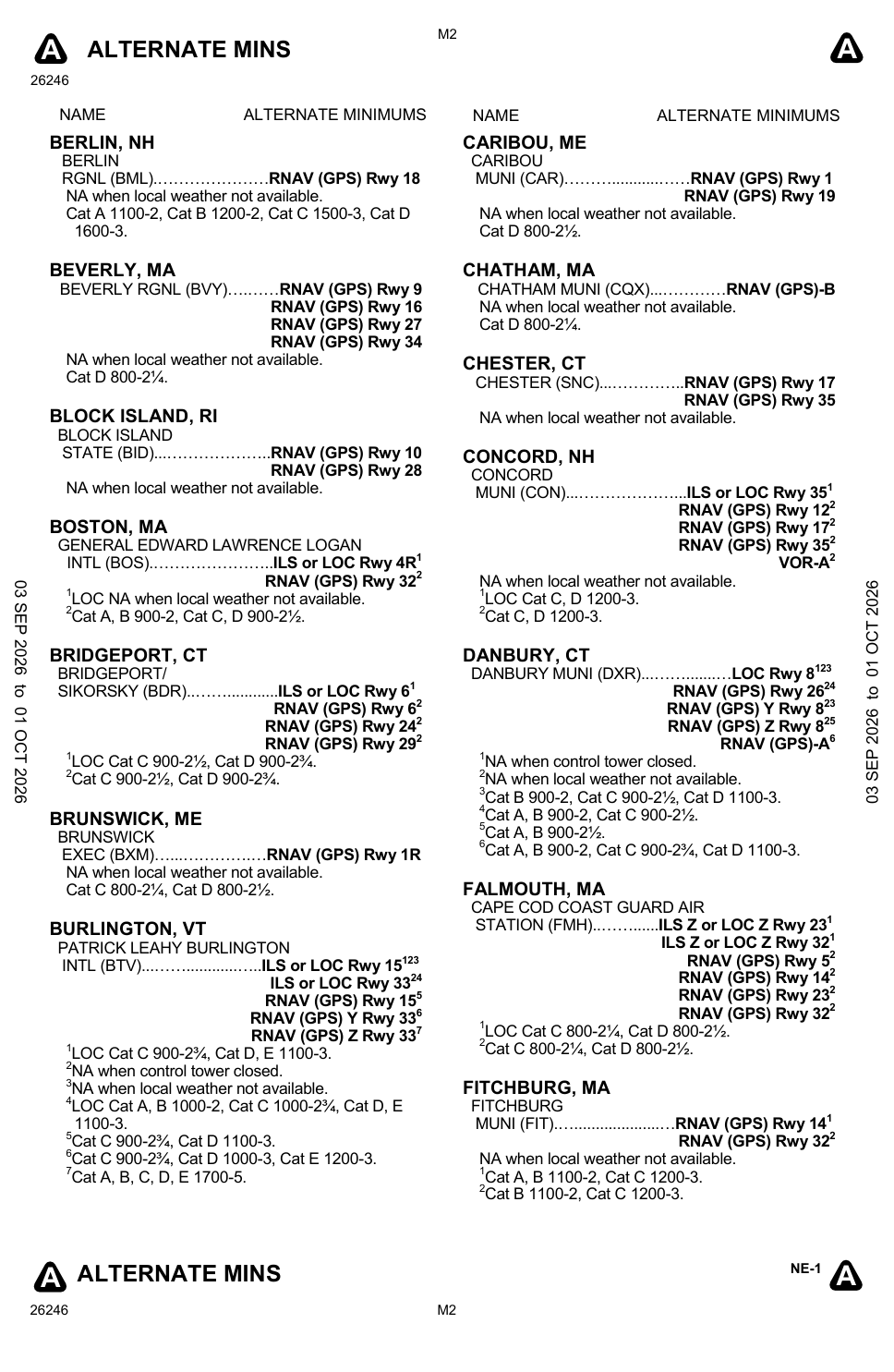
FAA d-TPP, cycle effective August 6 to September 3, 2026 -- for training only, not for navigation: pull the cycle in force before any flight.
5.GPS and the alternate airport
GPS adds one more wrinkle. Because GPS is not authorized as a substitute means of navigation guidance for flying a conventional approach at an alternate, an alternate whose only approach requires DME or ADF still needs the airplane to carry that DME or ADF equipment -- GPS cannot stand in for it there. For select RNAV (GPS) and GPS approach procedures, an alternate whose only instrument approach is GPS-based can be used only by aircraft with an approach-approved WAAS receiver meeting the applicable technical standard, or by TSO-C129/C196 receivers meeting the conditions published for that equipment.
Quick check
A pilot is planning an alternate whose only published instrument approach is an RNAV (GPS) procedure. The airplane has a certified, non-WAAS GPS receiver. What is the practical implication?
6.From legal minimum to a real decision
The regulatory minimum assumes an optimistic flight: no holding, one approach, a direct track. Real flights add a hold on arrival, a vector that adds distance, sometimes a full missed approach before the actual diversion even begins. Building in an hour of reserve beyond the destination, or setting a personal fuel floor that triggers a diversion decided on the ground rather than improvised in the air, turns a regulatory minimum into an actual safety margin.
- 1Calculate the leg to the destination using the actual forecast winds for the day, not a manual cruise figure.
- 2Apply the 1-2-3 rule against the arrival window to decide whether an alternate is required.
- 3Confirm the chosen alternate meets its planning minimums and is not marked NA.
- 4Add the destination-to-alternate leg, then the 45-minute reserve.
- 5Fix a personal fuel floor before takeoff that triggers a diversion, and treat it as a decision already made, not one to reconsider under pressure.
On the written test
Three numbers come up constantly on the written test: the 45-minute reserve in 91.167, the 1-2-3 window and figures in 91.169, and the 600-2 / 800-2 pair for standard alternate minimums depending on whether the alternate has a precision or non-precision approach.
What to remember
- 91.167 fuel is destination, plus the alternate leg if one is required, plus 45 minutes at normal cruising speed -- applied at takeoff, not maintained forever.
- The 1-2-3 rule: no alternate is required only if the destination has a published approach and the forecast, one hour before to one hour after ETA, calls for at least a 2,000-foot ceiling and 3 SM visibility.
- Standard alternate minimums are 600-2 for a precision approach, 800-2 for non-precision; a triangle-A on the chart sends you to non-standard values instead.
- Planning minimums decide what goes on the flight plan; the pilot flies the lower, published approach minimums if an actual diversion happens.
- GPS cannot substitute for conventional guidance at an alternate; WAAS and non-WAAS receivers face different conditions for using a GPS-only alternate.
Key terms
Try to recall each definition before turning the card.
FAA sources for this lesson
- 14 CFR 91.167 -- Fuel requirements for flight in IFR conditions
- 14 CFR 91.169 -- IFR flight plan: Information required
- Instrument Procedures Handbook (FAA-H-8083-16B), Chapter 1 -- Departure Procedures, IFR Alternate Requirements
End-of-lesson quiz
1.An alternate is required when the forecast at the destination, in the 1-2-3 window, shows:
2.What fuel reserve does 91.167 require beyond the planned route?
3.A planned alternate has only a non-precision approach published. What standard alternate minimums apply?
4.When an alternate is required, the fuel required by 91.167 equals:
5.An airport's NAVAID is unmonitored and it has no weather reporting capability. Can it be filed as an alternate?