Required IFR equipment
91.205(d) item by item, plus GRABCARD and what happens when something fails.
12 min read · The IFR system and its rules
After this lesson you can
- List the instruments and equipment 14 CFR 91.205(d) adds on top of day and night VFR requirements.
- Explain why GPS receivers are not all equally legal, and what RAIM and WAAS actually protect against.
- Describe, in general terms, how a pilot handles a piece of required equipment that fails before a flight.
An airplane equipped for day VFR is not automatically equipped for IFR. 14 CFR 91.205 builds in layers: the minimum for day VFR, then what night adds, then what paragraph (d) adds for IFR. Each layer sits on top of the one before it, and the IFR layer is where the panel starts to look like the one most people picture when they think of instrument flying.
Equally important is what is not a fixed list: navigation equipment. The rule asks only that it be 'appropriate to the route being flown,' which is deliberately elastic enough to cover a 1970s VOR panel and a modern GPS-only cockpit under the same sentence -- provided that equipment's own integrity can be trusted.
1.Equipment builds in layers
The basic instruments required for day VFR are simple: an airspeed indicator, an altimeter, and a magnetic direction indicator. Night VFR adds lighting and a few more items. IFR adds a further, more demanding layer on top of both, because now the pilot may have no outside visual reference at all.
Operation under IFR requires a gyroscopic rate-of-turn indicator, a slip-skid indicator, a sensitive altimeter adjustable for barometric pressure, a clock displaying hours, minutes, and seconds with a sweep-second pointer or digital display, a gyroscopic pitch-and-bank indicator (the attitude indicator), and a gyroscopic direction indicator (a heading indicator or equivalent). None of these are optional extras; each is there because, without outside references, the pilot has nothing else to fly the airplane by.
IFR flight requires specific instruments beyond the basic day VFR set. The gyros (attitude indicator, heading indicator, turn coordinator) provide attitude and bank reference when you can't see outside. Two-way radio, navigation receivers (VOR/GPS), and a sensitive altimeter are essential. The pitot-static system must be checked every 24 months (91.411) and transponder every 24 months (91.413).
2.The 91.205(d) list
Beyond the flight instruments themselves, paragraph (d) adds electrical and communication/navigation items. Many instrument students memorize the full list with the mnemonic GRABCARD, which reorders the items into something easier to recall than the order they appear in the regulation.
| Letter | Item | Detail |
|---|---|---|
| G | Generator or alternator | Of sufficient capacity for the electrical system installed |
| R | Radios | Two-way communication and navigation equipment appropriate to the route being flown |
| A | Attitude indicator | Gyroscopic pitch-and-bank indicator |
| B | Ball | Slip-skid indicator, most often the ball in the turn coordinator |
| C | Clock | Hours, minutes, seconds, sweep-second pointer or digital display |
| A | Altimeter | Sensitive altimeter adjustable for barometric pressure |
| R | Rate of turn indicator | Gyroscopic turn indicator |
| D | DME | Required at and above FL240 when a VOR is required for navigation (91.205(e)) |
Quick check
Which of these is the one 91.205(d) item that is only required above a specific altitude, rather than on every IFR flight?
3.Radios and navigation: "appropriate to the route"
The requirement for two-way communication and navigation equipment is written broadly on purpose: it demands the ability to fly the route filed and execute the procedures it requires, not a specific brand or generation of avionics. That wording is exactly why an airplane whose only navigation source is an IFR-approved GPS can be perfectly legal for IFR, even though the same requirement was written decades before satellite navigation existed.
- What it does not say — It does not require a VOR receiver, an ADF, or any particular technology by name -- only that whatever is installed can fly the filed route and any required approach.
- What it does require — That the equipment is actually installed, operational, and appropriate -- not merely present in the panel as a decoration from a previous owner.
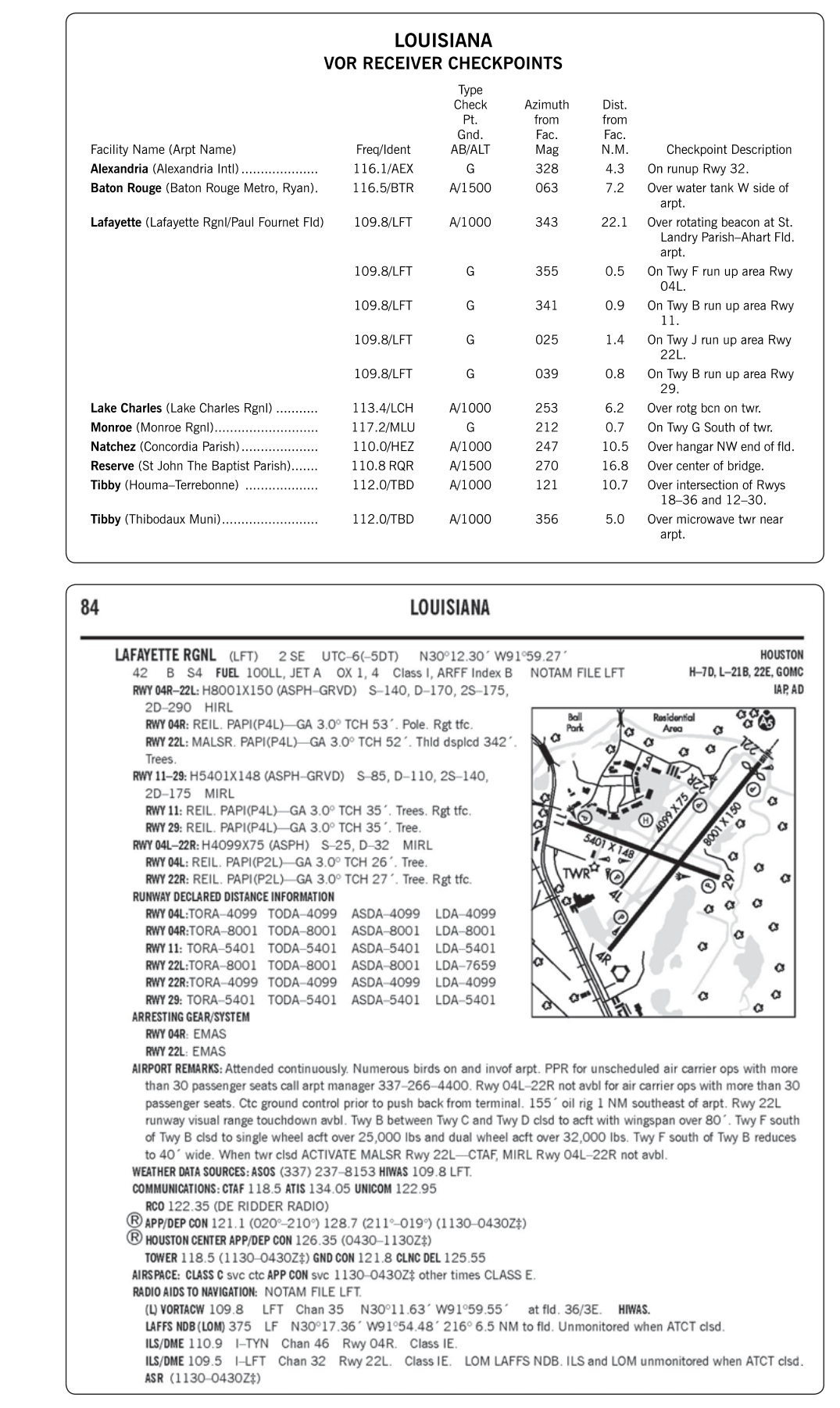
FAA Airman Knowledge Testing Supplement FAA-CT-8080-3F, Figure 64. Excerpt from Chart Supplement (LFT). A work of the U.S. government, free of copyright. For training only, not for navigation.
4.GPS integrity: RAIM and WAAS
Not every GPS receiver is legal for IFR navigation. Equipment approved only for VFR situational awareness -- including handheld units and tablets, however good their moving map looks -- cannot be used as the principal means of IFR navigation, for instrument approaches, or as a primary flight reference. A receiver has to be certified to the appropriate technical standard and installed under its own supplement to the aircraft flight manual.
The real question a certified receiver answers is not just where you are, but whether that position can be trusted. Receivers without satellite-based augmentation rely on receiver autonomous integrity monitoring, RAIM: the receiver checks its own solution against the satellites in view and flags when it cannot guarantee accuracy for the current phase of flight. RAIM needs a minimum of five satellites in view, or four plus a barometric altitude input, just to detect a problem, and six (or five with baro-aiding) to isolate and remove a bad satellite from the solution. Losing RAIM without an operating alternate means of navigation forces a delay, a reroute, or a cancellation.
WAAS receivers add corrections from geostationary satellites plus their own integrity message, which removes the RAIM-prediction step and opens up approach minimums with vertical guidance (LPV and LNAV/VNAV) that non-WAAS GPS cannot fly.
Caution
A handheld GPS or a tablet app, however capable, is not a substitute for a certified IFR navigator. It may be used as an aid to situational awareness during IFR flight, but it cannot be the equipment that satisfies 91.205(d) or that flies a published instrument procedure.
Quick check
A pilot's only navigation equipment is a certified, non-WAAS IFR GPS, and a RAIM outage is predicted for part of the route. What should the pilot do?
5.When required equipment fails
Aircraft with an approved minimum equipment list (MEL) follow that document when something fails: it states exactly what may be inoperative, under what conditions, and for how long. Most general aviation airplanes do not carry an MEL and instead work from the equipment lists in the type certificate, the requirements of 91.205 for the flight being flown, and any applicable airworthiness directives.
Whichever path applies, the practical steps look the same: confirm the failed item is not on any of those required-equipment lists for the flight planned, remove or deactivate it and placard it clearly as inoperative, and have the airplane's continued airworthiness confirmed and recorded before flight. A flight that is technically legal with one fewer instrument is not automatically a wise one to fly into weather.
- 1Identify exactly what has failed, and exactly what kind of flight is planned (IFR or VFR, day or night).
- 2Check whether that item appears on any equipment list the flight depends on for legality.
- 3Placard the inoperative item and, where applicable, deactivate or secure it.
- 4Have the airworthiness determination recorded before departure.
- 5Reassess honestly: a legal airplane with reduced equipment is not the same thing as a prudent one for the weather at hand.
6.Flight control systems, and why the type matters on instruments
The instrument ACS asks about flight control systems among the aircraft systems related to instrument flight, which surprises pilots who expect the list to be about vacuum pumps and alternators. The reason is feel: on instruments, the control system is the only channel through which the airplane tells you anything before the instruments do.
The Pilot's Handbook of Aeronautical Knowledge notes that flight control systems and their characteristics vary greatly with the type of aircraft. The most basic designs are mechanical and date back to early aircraft, working through rods, cables, pulleys and sometimes chains to transmit forces from the flight deck controls to the control surfaces - and they are still used today in small general aviation and sport category aircraft, where aerodynamic forces are not excessive.
That directness is what a light-airplane instrument pilot flies with. Control pressure varies with airspeed, so the airplane signals a speed change through the yoke before the airspeed indicator has moved far - which is exactly why the handbooks insist on fingertip control and on trimming precisely. A pilot gripping the controls has switched that channel off.
The instrument-relevant consequences are the trim system, which relieves the pressure so the scan can continue; the secondary controls - flaps and trim tabs - whose deployment changes pitch attitude and therefore the picture on the attitude indicator; and any powered or boosted system, where the feel a pilot has learned to read is manufactured rather than aerodynamic.
- Know which channel you have — A mechanically controlled airplane speaks through the yoke. A boosted or fly-by-wire installation gives you what its designers decided to give you, which is not the same information.
- Configuration changes move the picture — Flaps and trim change the attitude required for level flight. On instruments, that is a change to the reference you are flying against, and it should be anticipated rather than discovered.
What to remember
- 91.205(d) layers IFR equipment on top of day and night VFR requirements: attitude indicator, turn indicator, ball, sensitive altimeter, clock, generator, and appropriate radios.
- DME is only required at and above FL240, when VOR navigation is required for the route.
- Navigation equipment only needs to be "appropriate to the route," which is why GPS-only IFR panels are legal.
- RAIM protects non-WAAS GPS by monitoring signal integrity; WAAS adds corrections and its own integrity check, and unlocks vertically guided approach minimums.
- A handheld GPS or tablet is never a legal substitute for certified IFR navigation equipment.
Key terms
Try to recall each definition before turning the card.
FAA sources for this lesson
- 14 CFR 91.205(d) -- Instrument and equipment requirements
- Instrument Flying Handbook (FAA-H-8083-15B), Chapter 5 -- Flight Instruments
- Instrument Flying Handbook (FAA-H-8083-15B), Chapter 9 -- Navigation Systems, GPS Substitution and Function of GPS
End-of-lesson quiz
1.Which of these is NOT part of the 91.205(d) equipment added specifically for IFR flight?
2.At and above what altitude does DME (or a suitable RNAV system) become required, when VOR navigation is required for the route?
3.What is the main functional difference between a non-WAAS and a WAAS GPS receiver for IFR use?
4.A pilot wants to use a tablet-based GPS app as the sole means of navigation on an IFR flight plan. Is this legal?
5.An airplane has no approved minimum equipment list and a required instrument fails before departure. What is the correct general procedure?