Certifying the pilot and the airplane
Rating requirements, the 91.411 / 91.413 inspections, and the 91.171 VOR check.
13 min read · The IFR system and its rules
After this lesson you can
- Explain what an instrument rating adds to a pilot certificate and when it is required.
- State the two 24-month inspections every IFR airplane must carry, and what each one checks.
- Perform and log a VOR accuracy check within the tolerances allowed by 14 CFR 91.171.
- Recognize, before a flight, which of an airplane's IFR-related checks have quietly expired.
A VFR pilot only has to worry about one thing being current: the flight review, and maybe a medical. IFR flying doubles that bookkeeping. Two separate clocks have to be running at the same time -- one on the pilot, one on the airplane -- and either one running out grounds the flight just as surely as bad weather does.
This lesson is about the airplane's side of that bookkeeping and the rating that lets a pilot use it: what the instrument rating actually buys you, and the periodic checks -- 91.411, 91.413, 91.171 -- that keep the panel legal for flight into clouds. The pilot's side, the 61.57(c) currency clock, gets its own lesson later in this module.
1.Why fly on an instrument flight plan
A pilot flying only in familiar, uncongested areas, who stays alert to weather and is willing to reroute or cancel, may genuinely never need an instrument rating. The rating earns its keep on the flights that do not fit that description: an unfamiliar airport, a busy terminal area, marginal visual conditions that could tip into instrument conditions before the flight is over. Many accidents trace back to a VFR pilot pressing into weather without the skills or the equipment to fly by reference to instruments alone.
Two situations make the rating a legal requirement rather than a convenience. First, operating on an IFR flight plan in weather below VFR minimums. Second, any flight in Class A airspace, where IFR is the only way to operate at all. Outside those two cases, the decision is judgment, not regulation -- but it is a decision worth making before the weather makes it for you.
Flying IFR requires both a certified aircraft and a certified pilot. The aircraft needs specific equipment (91.205(d)) and the pilot needs an instrument rating (61.65). The instrument rating requires 50 hours of cross-country PIC time, 40 hours of instrument training, and passing both knowledge and practical tests. IFR is a system: you file, you get a clearance, you fly on instruments, ATC separates you from other IFR traffic.
Remember this
The rating does not make anyone an all-weather pilot. It certifies that you can plan and execute a flight under IFR, fly the basic instrument maneuvers, and have shown the skill and judgment to do so -- nothing more. The judgment to stay within your own limits is trained, not certified.
2.Adding the rating to your certificate
A private or commercial pilot adds the instrument rating through the same three-part structure as every other certificate or rating: the aeronautical knowledge and experience requirements of 14 CFR part 61, an FAA knowledge test, and a practical test (the checkride) once the experience requirements are satisfied. The regulations set minimum total and pilot-in-command time, and that minimum applies to every applicant regardless of prior experience -- it is a floor, not a target.
How long training actually takes depends on the individual: prior flying experience, rate of learning, frequency of lessons, and the quality of both ground and flight instruction. A professional pilot with varied experience may reach checkride-ready proficiency in close to the regulatory minimum. Someone starting from scratch, flying once a week, should expect it to take longer -- and that is a normal, not a failing, outcome.
- Ground training — Aeronautical knowledge can come from a school, a correspondence course, an appropriately rated instructor, or focused self-study for the knowledge test.
- Flight training — Delivered by a certificated flight instructor, in the airplane, in an approved simulator, or in a basic or advanced aviation training device (BATD / AATD).
- The practical test — Available only once the knowledge test has been passed and every experience requirement has been logged.
Pilot tip
Training devices are not a lesser substitute for instrument training -- they are a deliberate part of it. A BATD or AATD lets you drill instrument cross-check, holding entries, and approach sequencing without engine noise, turbulence, or a Hobbs meter running, and time in one counts toward the rating.
3.The figures are moving into the test questions
For decades the illustrations a knowledge test refers to -- charts, approach plates, performance tables -- were handed to you on test day as a separate printed booklet, the Airman Knowledge Testing Supplement. The FAA is now embedding those images directly in the questions instead, exam by exam. Instrument Rating Airplane is one of the tests already in that transition.
The date that matters for this rating: from October 26, 2026, the Instrument Rating Airplane knowledge test includes questions whose images do NOT appear in the printed supplement. A candidate who revised only from the paper booklet would meet figures on screen they had never seen. The FAA has not set a date for withdrawing the printed supplements from testing centers, and has said it will give notice before it does.
On the written test
Source: FAA Airman Testing Community Advisory, August 2026 edition, published on faa.gov under Training and Testing. Verified 31 August 2026. Check the current edition before your test date: this is a schedule, and schedules move.
4.The rating does not expire, the privilege does
Once earned, the instrument rating stays on the pilot certificate for life; there is no renewal, no retest to keep the paper valid. What can lapse is the privilege to use it: a pilot who has not met the recent experience requirements of 14 CFR 61.57(c) may not act as pilot in command under IFR, or in weather below VFR minimums, until that experience is restored. This module's currency lesson covers exactly what those six-month tasks are and what happens when they slip.
5.Two clocks on the airplane: 91.411 and 91.413
Two inspections, both on a 24 calendar month cycle, keep an airplane's instruments and transponder legal for IFR. Neither one depends on how the equipment feels in flight -- an altimeter that reads perfectly can still be illegal if the paperwork has lapsed.
| Check | What it confirms | Regulation |
|---|---|---|
| Static system, altimeter, and altitude-reporting equipment | That the altimeter and any encoder still report true pressure altitude to ATC within tolerance | 14 CFR 91.411 |
| ATC transponder | That the transponder replies correctly and accurately to ATC interrogations | 14 CFR 91.413 |
Quick check
An airplane's altimeter and transponder both work perfectly, but the last static/altimeter/transponder tests were 25 months ago. Is the airplane legal for an IFR flight?
6.The VOR check: 91.171
Any VOR used for IFR navigation must have been checked for accuracy within the preceding 30 days, and the pilot can usually do this alone. Three methods are approved: tune a VOR test facility (VOT) or a radiated test signal from a repair station, use a certified checkpoint on the airport surface, or use a certified airborne checkpoint. Locations and frequencies for VOTs and checkpoints are published in the Airport/Facility Directory.
A fourth method needs no ground facility at all: if the airplane has two independent VOR receivers, tune both to the same station and compare the indicated bearings against each other.
- Logging the check — The date and the observed error must be entered into the aircraft's permanent records. A radiated check from a repair station additionally requires an entry certifying the radial accuracy and the date.
- No unofficial corrections — Only the correction figures printed on the manufacturer's correction card may be applied when interpreting a check -- a pilot cannot invent a fudge factor to make a borderline reading pass.
- If it fails — An error beyond tolerance means the source of the error must be corrected before that VOR is used for IFR navigation again.
| Method | Maximum error | Notes |
|---|---|---|
| VOT or a certified ground checkpoint | 4 degrees | The more precise of the ground-based checks |
| Certified airborne checkpoint | 6 degrees | A wider tolerance because reception in flight is less controlled |
| Dual VOR receivers cross-checked against each other | 4 degrees difference between the two | No ground facility needed, but both receivers must share only the antenna |
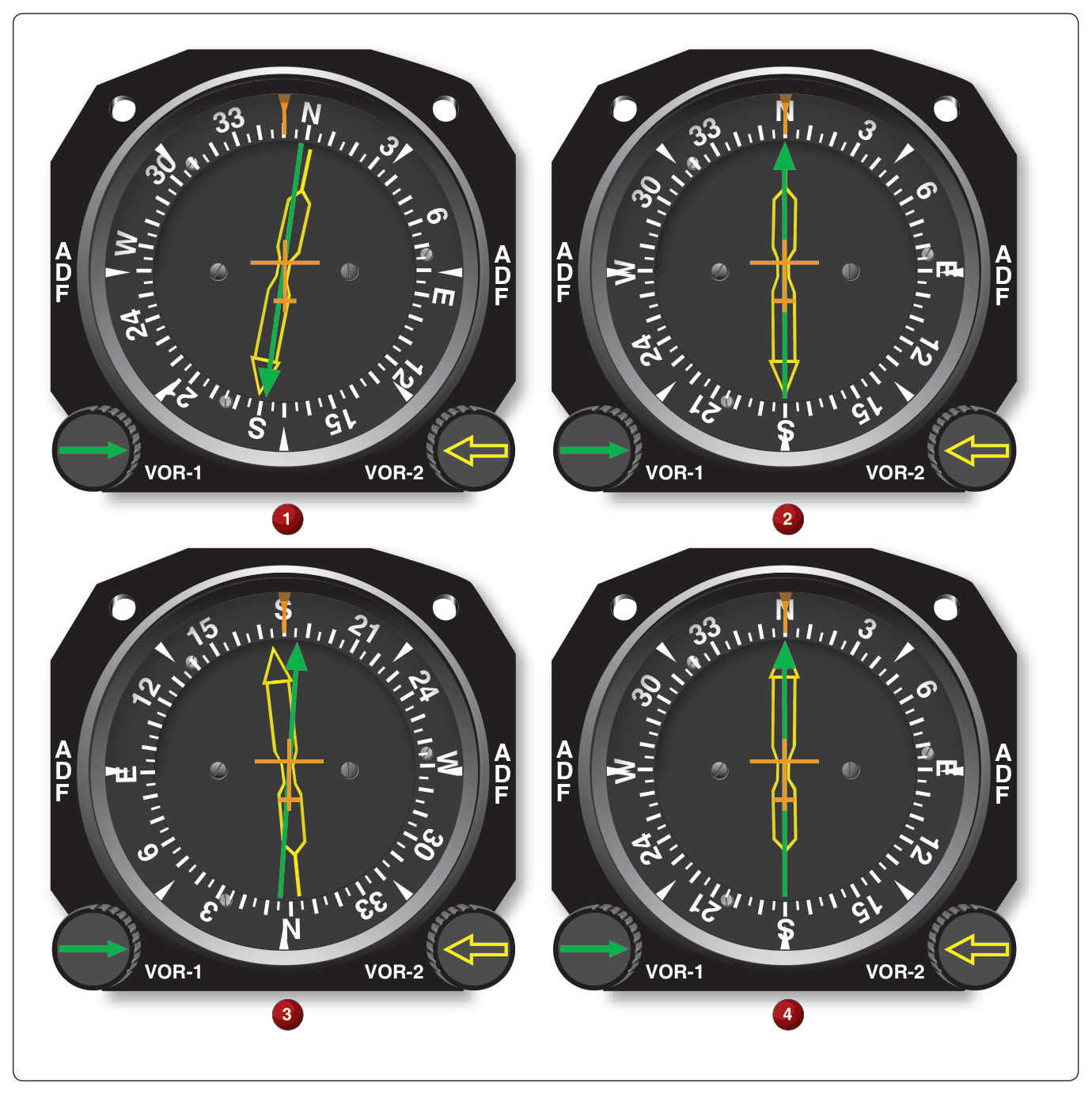
FAA Airman Knowledge Testing Supplement FAA-CT-8080-3F, Figure 81. Dual VOR System, VOT Check. A work of the U.S. government, free of copyright. For training only, not for navigation.
14 CFR 91.171
The rule affects IFR use of that particular VOR receiver, not the airplane's eligibility to fly VFR. A VOR that is thirty-one days past its check simply cannot be the basis for IFR navigation until it is rechecked.
Quick check
An airborne VOR checkpoint shows a 5-degree error. What is the correct conclusion?
7.Before you go: reading the airplane's paperwork
None of these checks are visible from the cockpit. They live in the maintenance records, and a five-minute logbook review before an IFR flight is what actually confirms the airplane is legal -- not a glance at the panel.
- 1Confirm the altimeter, static system, and transponder tests are dated within the last 24 calendar months (91.411 / 91.413).
- 2Confirm the VOR system has a logged accuracy check within the last 30 days, with the observed error recorded (91.171).
- 3Cross-check the annual inspection date, since an airplane out of annual is not airworthy for any flight, IFR or VFR.
- 4Check the Airport/Facility Directory and current NOTAMs for the status of every NAVAID the flight depends on -- a legal receiver is useless against a NAVAID that is out of service.
- 5Only then move on to the walk-around: pitot tube uncovered, static ports clear of dirt or obstructions, nothing disturbing the airflow around them.
On the written test
Three numbers come up constantly on the written test: 24 calendar months for both the 91.411 static/altimeter/transponder check and the 91.413 transponder check, and 30 days for the 91.171 VOR check. Notice the VOR check is the only one of the three a pilot can perform and log without a mechanic.
8.BasicMed, and what it does and does not carry into IFR
14 CFR part 68 contains the requirements for operating certain small aircraft without a medical certificate. It is an alternative pathway rather than a lesser medical: it rests on an examination by a state-licensed physician using a required checklist, together with a periodically renewed online education course, and it is open to pilots who have held an FAA medical certificate after a reference date.
What it authorizes is private pilot privileges. An instrument rating is a rating on the pilot certificate, not a separate class of medical, so an instrument-rated pilot operating under BasicMed exercises those same private privileges in IMC - and the instrument currency requirements of 14 CFR 61.57 apply exactly as they would otherwise. BasicMed changes the medical pathway and nothing about currency or ratings.
What it does not authorize is compensation. BasicMed does not permit acting as pilot in command for compensation or hire, or carrying persons or property for compensation - which is why a commercial certificate holder flying for pay needs a medical certificate rather than BasicMed.
Part 68 also imposes operating limits tied to the aircraft and the flight: a maximum number of occupants, a maximum weight, a capped altitude and speed, and a restriction on flying outside the United States without the permission of the country overflown. These specific figures have been revised over time, so they should be read in the current text of the regulation rather than remembered from a course.
The trap in an instrument context
Nothing about BasicMed relaxes an instrument requirement. The aircraft still needs its 91.205(d) equipment, the pilot still needs six approaches, holding and intercepting and tracking within the preceding six calendar months, and the altimeter and static system still need their 24-month check. A pilot who thinks of BasicMed as a simplified regime is simplifying the wrong list.
9.Unfamiliar aircraft, unfamiliar avionics
The instrument ACS lists the same risk twice - once against pilot qualifications and once against instrument flight itself: flying unfamiliar aircraft, or operating with unfamiliar flight display systems and avionics. The repetition is the point. It is a qualification question on the ground and a control question in cloud, and the second one arrives without warning.
The Pilot's Handbook of Aeronautical Knowledge sets the order plainly: before any pilot can master aircraft automation, he or she must first know how to fly the aircraft. Automation assists in many ways, but a thorough understanding of the systems in use is essential to gaining the benefits they offer, and understanding leads to respect, achieved through discipline and mastery.
Its test of that mastery is concrete and worth adopting as a personal standard: be able to fly the aircraft using minimal information from the primary flight display, including turns, climbs, descents and approaches. A pilot who can do that has a fallback. A pilot who cannot has a single point of failure with a screen.
The practical failure mode in an unfamiliar cockpit is rarely ignorance of what a system does. It is not knowing what mode it is in, where the annunciation for that mode appears, and which knob changes it - discovered while hand-flying an approach. That is why the transition happens in VMC, on the ground first, and why a transitioning pilot should insist on a proper training debriefing rather than accepting a tour of the panel.
A rented airplane is an unfamiliar airplane
The risk is not reserved for a new type. The same make and model with a different avionics suite, a different autopilot, or the same suite at a different software version is unfamiliar in every way that matters at 200 feet above minimums. Treat the question as being about the specific installation, not the airframe.
10.Fit to fly on instruments: the pilot's side of the paperwork
The instrument ACS lists fitness for flight and the physiological factors that might affect the pilot's ability to fly under instrument conditions as a risk under pilot qualifications, and the instrument case is sharper than the VFR one. The Pilot's Handbook of Aeronautical Knowledge's IMSAFE checklist, illness, medication, stress, alcohol, fatigue and emotion, is the standard tool, and each item costs more in cloud than in the clear: an instrument pilot has no horizon to fall back on when judgment or attention degrades, and the workload of an approach leaves no spare capacity to absorb a deficit.
Three items bite hardest. Spatial disorientation is the instrument pilot's occupational hazard, and the handbook describes how the vestibular illusions, the leans, the graveyard spiral, the Coriolis illusion, are produced by exactly the inputs instrument flight involves: prolonged constant-rate turns, head movements while turning, and accelerations with no visual reference. Fatigue, which the handbook calls one of the most insidious hazards because it may not be apparent until serious errors are made, degrades the cross-check first and the interpretation second, so that a tired pilot flies the approach one instrument behind. And medication: the handbook's rule of waiting at least 48 hours after a new medication, and five dosing intervals after the last dose, exists because side effects that would be a nuisance in VMC are a partial-panel emergency in IMC.
The handbook's remedy is the one it gives for the airplane's paperwork: check before the walk-around, not after. IMSAFE is answered honestly on the ground, where a no costs a cancelled flight; answered in cloud, it costs an approach. The instrument pilot's addition is a specific question about the head: a cold that blocks an ear, or a recent bout of vertigo, is a disqualifying condition for a flight that will end in a descent through cloud, whatever 61.53 says about medical certificates in general.
| Item | The question | Why it matters more in IMC |
|---|---|---|
| Illness | Any symptoms, especially a cold or ear or sinus trouble? | A blocked ear on the descent through cloud, with no outside reference to distract from the pain |
| Medication | Anything new within 48 hours, or within five dosing intervals of the last dose? | Drowsiness or slowed reaction on an approach at minimums |
| Stress | Anything on the mind that will follow you into the cockpit? | Attention narrows; the cross-check stops |
| Alcohol | Within 8 hours? Within 24 hours? | Susceptibility to disorientation and hypoxia, both worse without a horizon |
| Fatigue | Rested? A full night's sleep? | The insidious one: not apparent until the error is made, and errors on instruments compound |
| Emotion | Upset, angry, grieving? | Judgment on the go or no-go, and on the missed approach decision |
The rating does not immunize
The handbook describes the illusions of spatial disorientation as affecting every pilot; training teaches you to distrust them, not to stop feeling them. A pilot who is tired, medicated or unwell feels them more strongly and distrusts them less. That is the physiological factor the ACS is asking about, and the answer is a decision made on the ground.
What to remember
- The instrument rating never expires; the privilege to use it under 61.57(c) does, and that is a separate lesson.
- 91.411 and 91.413 both run on a 24-calendar-month clock and cover the static system/altimeter/encoder and the transponder.
- 91.171 requires a VOR accuracy check within the preceding 30 days: 4 degrees for a VOT or ground checkpoint, 6 degrees airborne, 4 degrees between two cross-checked receivers.
- Every one of these checks is a paperwork question, not a "does it look fine" question -- verify dates before the walk-around, not after.
Key terms
Try to recall each definition before turning the card.
FAA sources for this lesson
- 14 CFR 91.171 -- VOR equipment check for IFR operations
- 14 CFR 91.411 and 91.413 -- Altimeter, static system, and ATC transponder tests
- Instrument Flying Handbook (FAA-H-8083-15B), Introduction -- Is an Instrument Rating Necessary? / Instrument Rating Requirements
- Instrument Flying Handbook (FAA-H-8083-15B), Chapter 9 -- Navigation Systems, VOR Accuracy
End-of-lesson quiz
1.What is required for a private pilot to legally act as pilot in command on an IFR flight plan?
2.Which two inspections share the same 24-calendar-month interval?
3.A dual-VOR cross-check shows the two receivers disagreeing by 5 degrees. What does 91.171 say?
4.What can a pilot use to correct an out-of-tolerance VOR reading?
5.An airplane has a valid annual inspection and a functioning panel, but the last VOR check was 45 days ago. What is true?